 Manda
MandaWhat Is the TOCFL Chinese Exam?
The Manda Team · · 12 min read
If you're learning Mandarin and thinking about studying, working, or getting permanent residency in Taiwan, you've probably run into the name TOCFL. It's Taiwan's official Mandarin Chinese proficiency exam for non-native speakers, and increasingly it's becoming a standard credential for university admissions, scholarships, and even some job applications. This guide breaks down exactly what the TOCFL is, how it's structured, how it compares to the HSK, and what to expect if you decide to sit it.
What Does TOCFL Stand For?
TOCFL stands for Test of Chinese as a Foreign Language (華語文能力測驗). It's administered by the Steering Committee for the Test of Proficiency-Huayu (SC-TOP), an organization affiliated with National Taiwan Normal University and operating under Taiwan's Ministry of Education.
The TOCFL measures Mandarin proficiency for anyone who isn't a Taiwanese citizen: international students, professionals, expats, and overseas Chinese learners alike. Unlike some exams, it isn't a pass/fail test in the traditional sense: you sit the exam and receive a proficiency level based on your score, similar to how the IELTS or TOEFL work for English.
TOCFL vs. HSK: What's the Difference?
The HSK (Hanyu Shuiping Kaoshi) is the equivalent exam used in mainland China, and it's often the first one learners hear about. The two are not interchangeable, and the differences matter depending on where you're headed:
- Character set: HSK uses Simplified Chinese characters only. TOCFL lets candidates choose between Simplified and Traditional characters at registration, though Traditional is the standard in Taiwan.
- Geography: TOCFL cannot be taken in mainland China, Hong Kong, or Macau, and conversely the HSK is not offered in Taiwan.
- Recognition: HSK is generally required for programs and scholarships tied to mainland China, while TOCFL is the standard for Taiwanese universities, the MOFA Taiwan Scholarship, and increasingly for employment in Taiwan-based companies.
- Vocabulary demands: TOCFL is widely considered the more vocabulary-heavy of the two exams. Its top level requires roughly 8,000 words, compared to around 5,000 for the pre-2021 HSK's highest level.
The table below shows how cumulative vocabulary requirements stack up across the two most common Chinese proficiency frameworks, plus the CEFR scale they're both mapped to.
TOCFL vs. HSK Vocabulary Size by Level
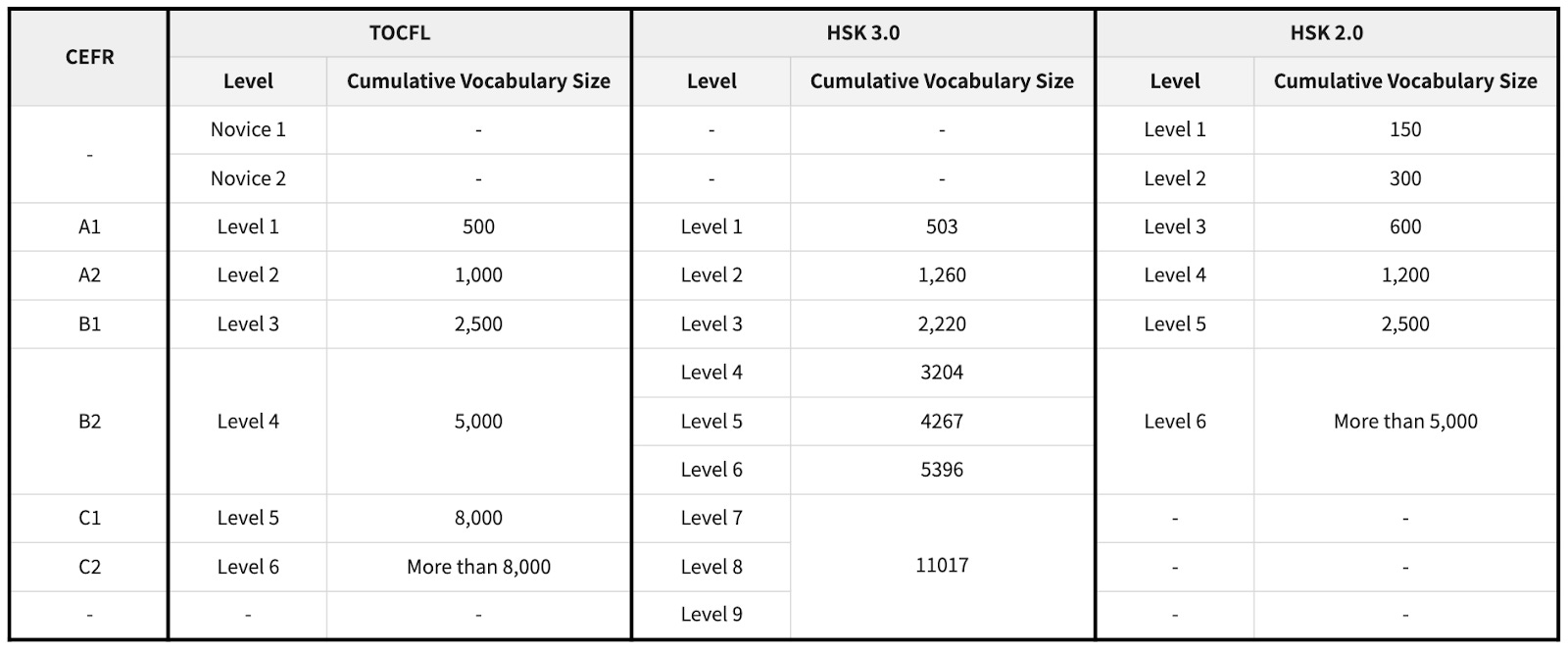
HSK 3.0 Levels 7, 8, and 9 share a combined cumulative vocabulary target of 11,017 words.
Notice how steep the jump is at the top of the TOCFL scale (going from 5,000 words at B2 to 8,000 at C1) compared to HSK 3.0's more gradual climb. This is one reason learners who cross over from HSK-based study often find the top of the TOCFL noticeably harder than they expected.
The TOCFL Band and Level System
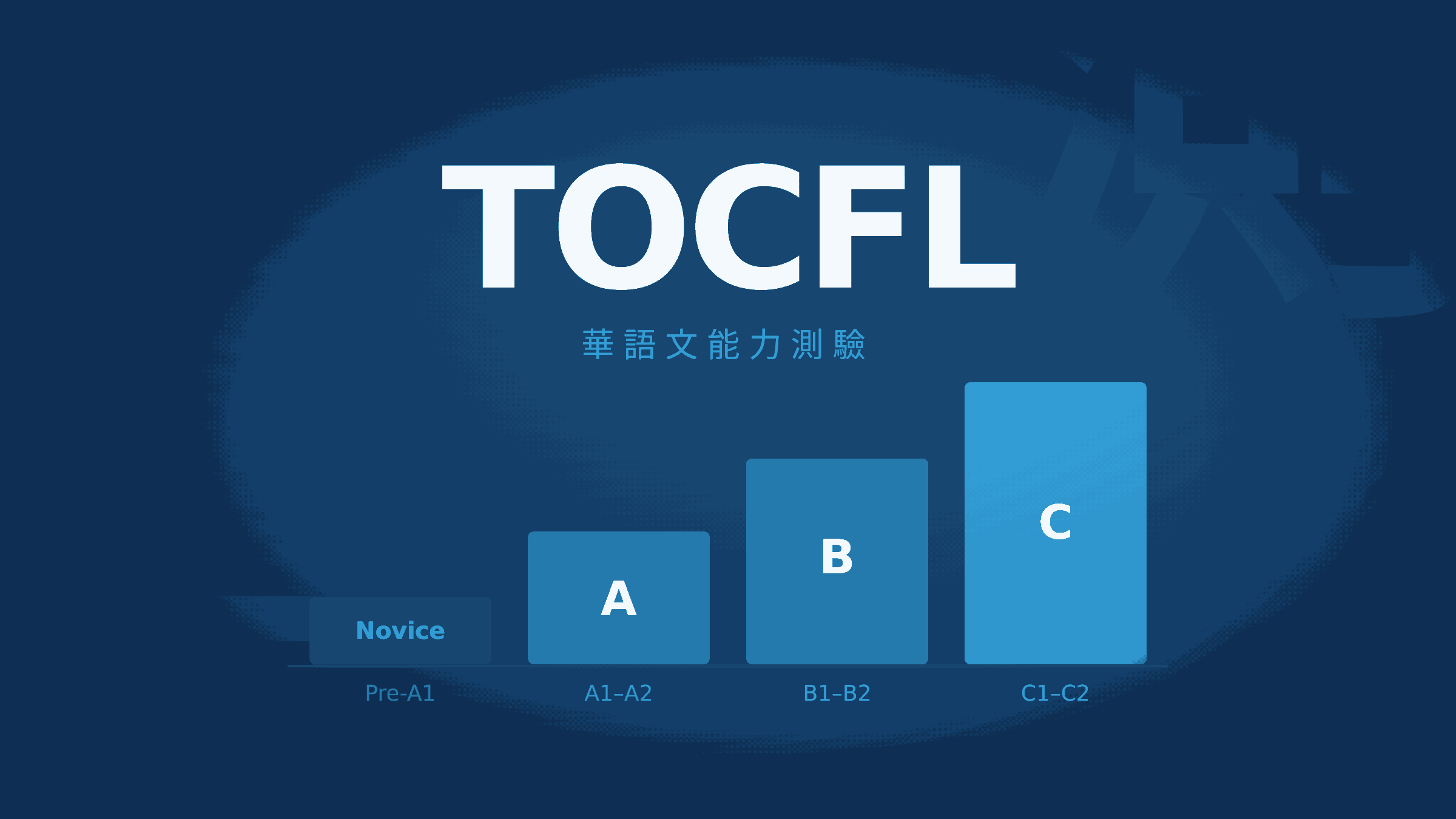
The TOCFL organises proficiency into four bands and eight levels in total:
| Band | Levels | CEFR Equivalent |
|---|---|---|
| Novice | Novice 1, Novice 2 | Pre-A1 |
| Band A | Level 1, Level 2 | A1, A2 |
| Band B | Level 3, Level 4 | B1, B2 |
| Band C | Level 5, Level 6 | C1, C2 |
Each band roughly corresponds to a stage of communicative ability:
- Novice: absolute beginner, foundational survival Mandarin
- Band A: everyday topics, basic dialogues, familiar contexts
- Band B: conversational fluency, expanded vocabulary, navigating diverse situations
- Band C: abstract and academic topics, rapid speech, idiomatic and professional-level language
For most working professionals and university applicants, Band B Level 4 has become something of an informal baseline for "professional credibility" in Mandarin, while Band C signals advanced fluency.
What Does the TOCFL Actually Test?
The TOCFL evaluates four skills, but not all through a single test. It's split into separate exams:
1. Listening & Reading
This is the core exam most people mean when they say "TOCFL," and it's usually taken as a single sitting. It's delivered as multiple-choice questions, with no dedicated grammar section: grammar is tested implicitly through comprehension.
Many test centres now use the CAT (Computerized Adaptive Test) format. Rather than giving every candidate identical questions, a CAT exam adjusts the difficulty of each subsequent question in real time based on whether you answered the previous one correctly. Answer well, and you'll be pushed toward harder material; struggle, and the difficulty eases. This lets test-takers across a wide range of abilities sit a single unified exam, with the software narrowing in on an accurate proficiency estimate by the end.
A few practical points about the format:
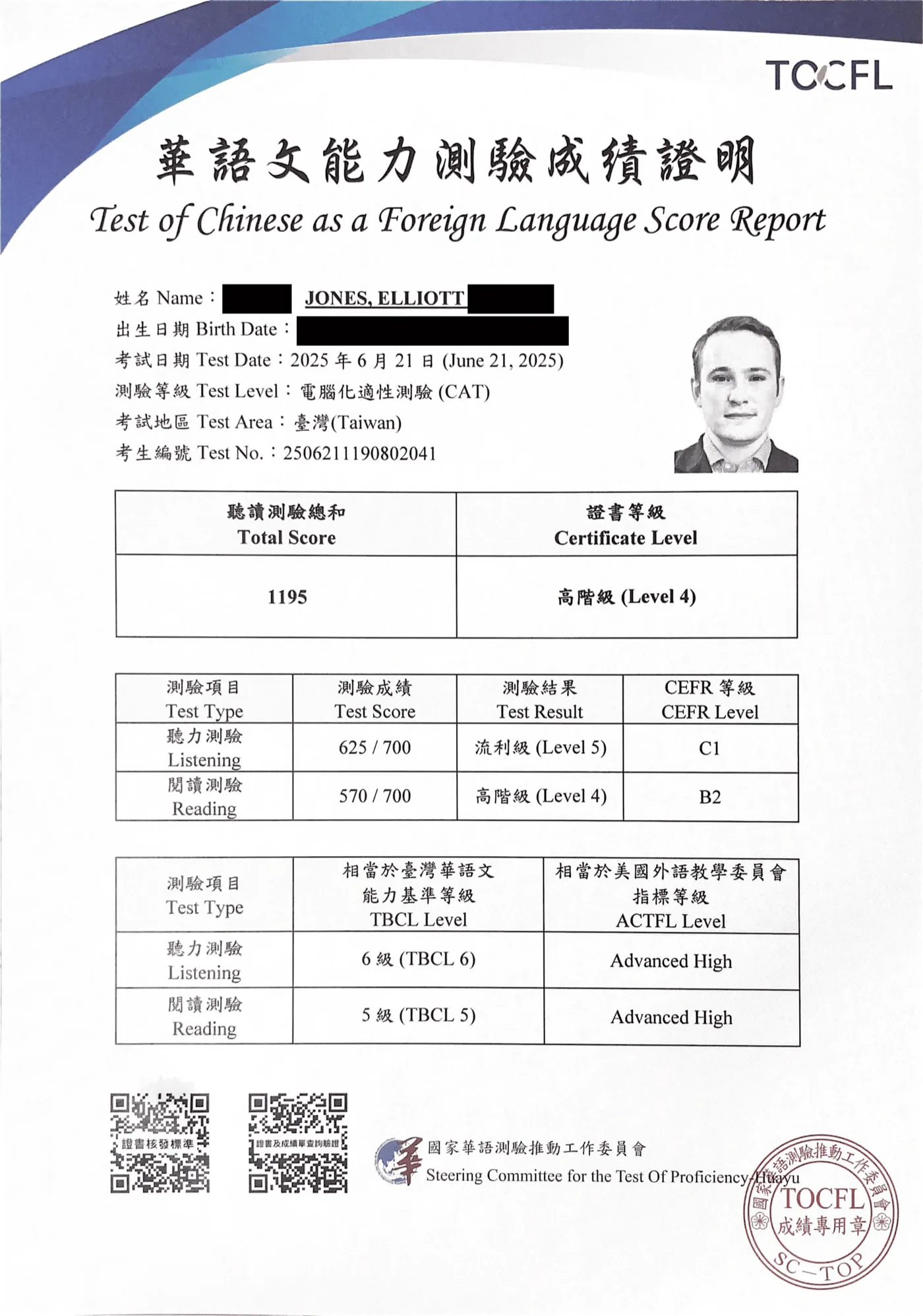
- Listening and reading are scored separately, typically out of 700 points each, but your final certificate level is determined by the combined total of both scores.
- It's possible to score high enough for one level on listening but not on reading (or vice versa). In that case, your certificate reflects whichever level your combined score qualifies for, even if your score report shows a higher result for one section individually.
- Each level requires a minimum combined threshold. For example, Level 4 (B2) generally requires a combined score of around 1,125 out of 1,400 across listening and reading together.
- Because the test is computer-delivered, audio and equipment reliability at your assigned station matters: technical issues can cost real points since missed listening items typically can't be replayed.
Here's what a real CAT score report looks like: the individual section results can differ from the certificate level because the certificate is determined by the combined total:
The non-CAT version of the Listening & Reading test is broken down by band, with format and question types increasing in complexity:
- Novice: 2–3 sections, around 25 multiple-choice items, roughly 25 minutes
- Band A: Picture description, single- and multi-round dialogues, and text-based dialogue questions: 50 items, about 60 minutes
- Band B / Band C: Dialogue and monologue sections, 50 text-based multiple-choice items, about 60 minutes
2. Speaking
The Speaking test is administered separately from Listening & Reading and is split by band, which determines the maximum level you're eligible for:
- Band B (Levels 3–4): Questions are read aloud to you, so you respond based on what you hear, meaning strong listening comprehension alone is enough to access the test.
- Band C (Levels 5–6): You must read the questions yourself before answering aloud, meaning Band C reading ability is effectively a prerequisite even though it's a speaking exam.
The Band B Speaking test follows a consistent four-part structure: a short warm-up (30–45 seconds on everyday personal topics), an experience description where you recount a memorable event (1.5 minutes), a picture description where you analyse an image and share related perspectives (1.5 minutes), and an opinion statement where you take a position on a social issue with supporting reasons (2 minutes). For the longer tasks you receive about one minute of preparation time, and pen and paper are provided for notes. Responses are recorded: you speak into a microphone at your workstation.
One common pitfall worth flagging: opinion and hypothetical questions sometimes require specialised vocabulary in specific domains (legal, postal, medical, etc.) that standard study materials don't always cover well. Practising a range of topics in depth, rather than cycling quickly through many prompts, helps build the vocabulary reserves these questions demand.
This creates a common bottleneck: some learners have spoken Mandarin well beyond Band B, but can't yet access the Band C speaking test because their reading hasn't caught up. Response tasks are timed, so being comfortable with the pacing of the exam format in advance can make a meaningful difference to your score.
3. Writing
The Writing test is computer-based and requires you to type in Chinese: either via Pinyin or Bopomofo (ㄅㄆㄇㄈ) input methods. There is no handwriting component. If you plan to take the Writing test and aren't already comfortable typing Chinese on a keyboard, building that fluency beforehand is a practical necessity, not an afterthought.
For Band B, the test consists of two written tasks totalling around 450–550 words: a formal letter in Chinese epistolary format (correct headers, appropriate tone, addressing all specified content points) and an argumentative essay presenting a clear position on a social issue with concrete supporting examples and logical transitions. Scoring across all bands considers three dimensions: content organisation and completeness, expressive fluency and cohesion, and grammar accuracy alongside vocabulary range. Like Speaking, the Writing test is administered and certified separately from the Listening & Reading exam.
How Long Is a TOCFL Certificate Valid?
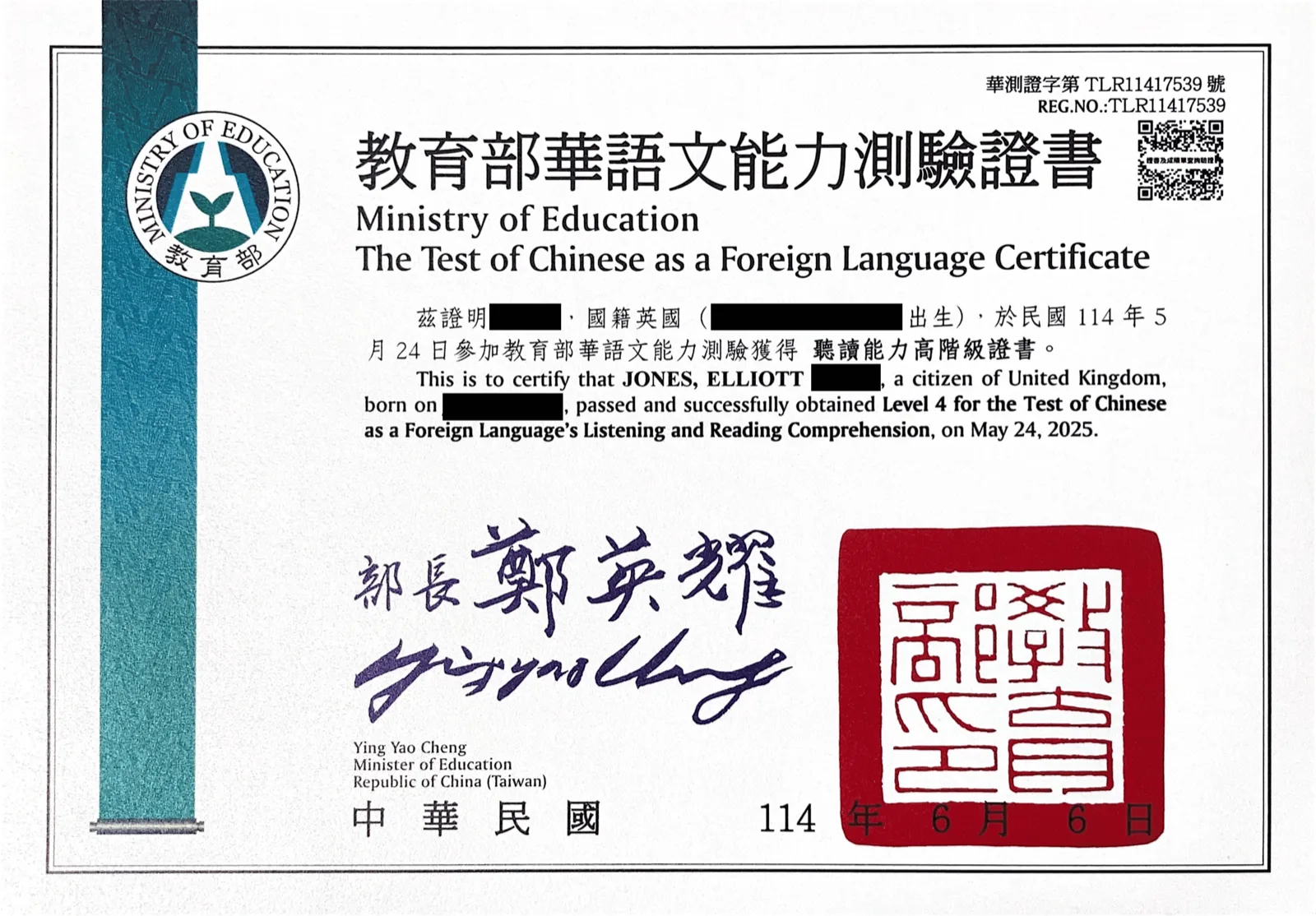
TOCFL certificates are valid for three years from the test date, similar to other international proficiency exams like the TOPIK (Korean) or the TEF (French). After that period, you'll need to retake the exam for the certification to count toward new applications.
Where Can You Take the TOCFL?
While the exam originates in Taiwan, SC-TOP has offered overseas testing since 2006, and the network of test centres has grown steadily since. As of recent counts, there are test centres across dozens of countries, including major cities in Japan, South Korea, Vietnam, Indonesia, Malaysia, Australia, India, Thailand, and beyond, in addition to around 20 centres within Taiwan itself.
Who Needs a TOCFL Certificate?
- University applicants: Many undergraduate and graduate programs in Taiwan require a TOCFL certificate (or use it to help place) international applicants by Chinese proficiency.
- Scholarship applicants: Programs like the MOFA Taiwan Scholarship often list a TOCFL level as an eligibility requirement.
- Job seekers and professionals: Companies operating in Taiwan increasingly reference TOCFL levels: Band B is common for general professional roles, with Band C signalling advanced fluency for more senior or client-facing positions.
- Residency and visa applications: Certain long-term visa or permanent residency pathways in Taiwan may accept or require proof of Mandarin proficiency, for which a TOCFL certificate is one recognised option.
How to Prepare for the TOCFL
A few strategies consistently show up in the experiences of successful test-takers:
- Study the official vocabulary lists directly. Each level has a defined, publicly available vocabulary set: work through it level by level rather than guessing at what might come up. Manda has the complete TOCFL word lists organised by level, with pinyin and definitions built in, so there's no need to hunt for third-party Anki decks or assemble your own.
- Pair vocabulary study with spaced repetition. Flashcard apps are effective for closing character-recognition gaps, but flashcards alone can become a grind over a long study period. Mixing in other study modes, cloze, passage, and matching exercises, keeps review fresher and tests recall in slightly different ways, which tends to produce more durable retention than a single card format.
- Build reading ability through real texts at your level. Structured textbooks (such as the widely used A Course in Contemporary Chinese series) build reading reliably through level-appropriate progression. Beyond textbooks, reading graded stories, articles, and news at your current TOCFL level bridges the gap toward native material. Manda's graded library shows TOCFL difficulty ratings so you can target the right level without guessing, and the interactive reader lets you tap any unfamiliar word for an instant definition without leaving the page.
- Train reading speed, not just accuracy. The CAT Listening & Reading exam rewards candidates who can process text at pace. Speed reading practice (reading one word at a time at a controlled rate, then gradually increasing it) builds the kind of fluency where decoding stops eating your comprehension budget. Even a few weeks of short daily sessions at your current level makes a noticeable difference.
- Use native audio content for listening stamina. Podcasts, dramas, and other native-level media build the listening speed and tolerance for rapid, idiomatic speech that the higher bands demand. Passive listening exposure (even without full comprehension) accelerates the point at which natural-paced speech stops feeling fast.
- Practise with official mock exams. Real TOCFL-format practice (especially CAT-format questions) helps you get comfortable with the adaptive difficulty curve, the pacing, and the question style before sitting the real thing. SC-TOP publishes official sample questions for each band.
- Target your weak skill directly. Listening and reading often develop at different speeds, especially for learners who picked up spoken Chinese through daily conversation rather than formal study. Reviewing your score report by section makes it clear which side is limiting your certificate level.
- For Writing candidates: sort out your input method early. The Writing test is entirely computer-typed, with no handwriting. If you aren't already comfortable with Pinyin or Bopomofo input, practise that skill before you register. Many learners discover this requirement late and waste preparation time learning to type instead of practising writing.
- For Speaking: go deep on fewer topics. Cycling rapidly through many prompts during practice is less effective than spending 10+ minutes thoroughly exploring a single topic: hypothetical scenarios and opinion questions reward the kind of extended vocabulary depth that rapid rotation doesn't build.
Final Thoughts
The TOCFL isn't a pass/fail gate: it's a proficiency measurement, and there's no limit on how many times you can take it. If your first attempt doesn't land the level you wanted, the standard approach is to review your score report, identify whether listening or reading (or speaking, or writing) is holding you back, and adjust your study plan accordingly before registering again.
Whether you're aiming for a Band A certificate to prove basic conversational ability or working toward Band C for professional-level fluency, understanding the exam's structure (the bands, the scoring system, and what each section actually demands) is the first step to building an effective study plan.